
Showing posts with label Rose Hips. Show all posts
Showing posts with label Rose Hips. Show all posts

Rose hips are in season! I have mentioned them before on my blog, but don't think I have given them their fair share of the spotlight!
Here is a ripe rose hip growing on a wild rose bush. You can see where the wild rose petals fell off, and all that remains is the bud below it. All summer, the bud was green, and in the fall, they begin to turn a bright beautiful red!

The rose hips I found on our property were quite small... but they are a powerhouse packed full of vitamin C, and I collected all I could find!

So I have diligently been collecting rose hips around our property the last few days since most of them began turning red. Here is my small collection after a couple of days of looking! My husband even joined in, bringing me 2 or 3 to add to my collection as he was working out in the yard and came across them.

Somehow a dear friend, RH, found out I was searching for rose hips (and not having much luck), and she gifted me by picking this jar full of rose hips for my birthday! They were in full bloom abundantly all over her property, and what a beautiful gift it was!
Now if you are wondering what all the "hype" is about rose hips, please read on! I would like to share with you a few facts I've learned about rose hips, how to find them, how to store them, and how to enjoy them!
A rose hip is the fruit of the rose that grows underneath the rose after it has bloomed. If the rose was not picked, but allowed to die/dry on the vine, a rose hip will be produced. The rose hips are green throughout the summer, but in about August/September the green rose hip starts to turn into a gorgeous shade of red. Once fully red and soft, the rose hip is ready to be picked. It does help if you wait until after the first frost, because the rose hip will have a sweeter taste then.
Rose hips grow on just about any rose bush, but the kind I am talking about today are the wild roses that grow freely here all over Idaho. However, you can use any rose hip that you are able to find, just make sure that they have not been sprayed, or had chemicals of any kind on them.
The reason rose hips are such a valuable food source is because of the high level of vitamin C (and other vitamins) found in the rose hip. Fresh rose hips contain the most vitamin C. After storing (dried) rose hips, the levels of vitamin C drop. However, if the fresh rose hip is consumed fresh or if it is frozen immediately after picking, it retains much more of the vitamin C content. (See here for more information).
Fresh wild rose hips are rich in vitamin C, vitamin E, vitamin K, flavonoids and other essential fatty acids that help to keep your bones, muscles, and joints working together properly, as well as they help to boost the red blood cells in your body, which works as an immune support system. So you can see what a mighty powerhouse the rose hips are for your body!
After doing some research, it appears that drinking fresh rose hip tea is the best way to enjoy these vitamin C, E, & K packed fruit. Drying/processing causes the rose hips to lose much of their nutritional value. So, the best thing about the method I am going to show you is this - once you brew the tea, it can be frozen, and you will not lose much of the vitamin C content, as opposed to drying and storing the rose hips. This appears to be the best way to retain the nutrient value from the rose hips in the best way possible.
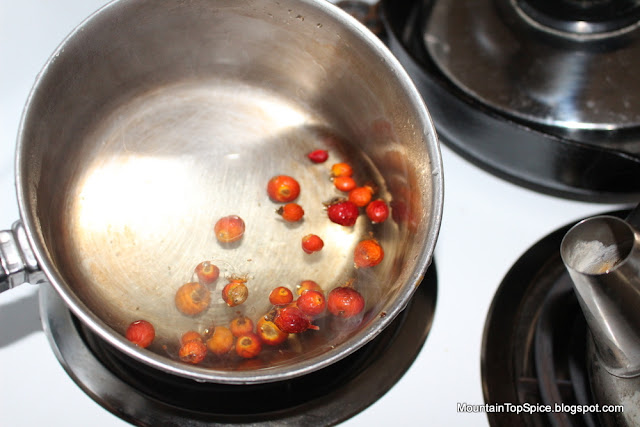
For today's post, I simply used the rose hips that I had gathered on my property. I used about 2 tablespoons of fresh rose hips. I washed them, and cleaned both ends of the hips, and then placed them in about 1 cup of water.
It is necessary to mention here that you do NOT want to work with rose hips using aluminum pans, but to use stainless steel, glass etc. The aluminum pot (and utensils) will react with the precious vitamin C, and cause you to lose precious valuable vitamin C content.

That being said, I brought the cup of water to a boil in a stainless steel pan, and let it simmer gently for 15 minutes.

And then it was time to enjoy my rose hip tea! I poured the tea into my beautiful tea cup and stirred in a dab of honey.

And drank to my health!
Now, if you have collected a lot of rose hips, and want to store them in the best way possible to get all the vitamin C, E and K you can from them, you can use this recipe of approximately 2 tablespoons of fresh rose hips to one cup of water, bring to a boil, and simmer for 10-15 minutes. (If you are using dried rose hips, you can use 2 tsp per 1 cup water).
Once the tea has cooled, you can then pour the rose hip tea into ice cube trays and freeze. Once frozen, remove from ice cube trays and store in a freezer container labeled "rose hips" (so you won't forget what they are!) Then, throughout the winter, whenever you want a boost of fresh vitamin C, you can pull a rose hip tea cube from your freezer, and place it into a cup of hot tea for that added vitamin C boost!
What does vitamin C do, you may ask? That is a good question!
Let me, in my own words, after doing some research, attempt to explain it as simply as possible.
Vitamin C (also known as ascorbic acid) is valuable in preventing and treating cold and flu symptoms. Vitamin C also plays an important role in supporting bones, connective tissues, muscles, and blood vessels. The body needs vitamin C to help absorb iron, and iron is needed for red blood cell production. In a roundabout way, vitamin C boosts your red blood cells, and keeps your immune system healthy and active. If you feel that your immune system is under attack (cold, flu, virus), then you can up your vitamin C intake to 500 mg a day. Some people take up to 2000 mg of vitamin C a day, but this is only in a severe case of a virus or flu attack.
Since vitamin C helps with your connective tissues, it is important to note that taking extra vitamin C as you grow older will help maintain your connective tissues, and may even work to prevent arthritis, or joint problems. If you have a vitamin C deficiency, you may experience loosening of your teeth, bleeding gums, bleeding under your skin, and swelling in your joints.
The FDA recommends that men need 90 mg of vitamin C a day, and women need 75 mg a day.
I wondered how much vitamin C is found in an average rose hip. It was hard to pin down that information, but I did find one website here that says this: Fresh rose hip contains between 0.5-1.7% vitamin C (5, 8) and is estimated to contain 1250 mg vitamin C per 100 grams of rose hip (6). However, much of the vitamin C is destroyed during drying and processing(11), and declines rapidly with storage (2)
I checked another website and found this:
Fresh rose hips contain 0.5 to 1.7% vitamin C. However, the vitamin C content of dried, commercially available rose hips products varies considerably. While some accounts suggest that rose hips are the richest natural source of vitamin C, a number of more concentrated sources have been identified. Citrus fruits contain approximately 50 mg vitamin C per 100 g; uncooked broccoli, kale, and kiwi fruit, approximately 100 mg; black currants, guavas, and some tropical vegetables, 200 to 300 mg; rose hips (Rosa canina), 1,250 mg; acerola or Barbados cherry (Malpighia punicifolia), 1,000 to 2,330 mg; and Terminalia ferdinandiana, up to 3,150 mg. In addition to vitamin C, rose hips also contain vitamins A, B1, B2, B3, and K. Other ingredients include pectin, tannins, flavonoids, carotenoids, and a variety of minor components.
In simpler form:
Citrus fruit - 50 mg vitamin C per 100 gm
Uncooked broccoli, kale, kiwi - 100 mg per 100 gm
Black currants, guavas, and tropic vegetables - 200-300 mg per 100 gm
Rose hips - 1250 mg per 100 gm
Acerola/Barbados cherry - 1000-2300 mg
Using the gm per gm measurement, fresh rose hips have 25 times more vitamin C in them then an orange! Quite impressive!
You can buy dried rose hips at just about any online herbal store; however, be aware that the quantity and quality of the vitamin C deteriorates with drying and processing. Freezing the tea is your best bet for maximizing the benefits of rose hips!
If you would like to do more research on your own, here are some links that you can visit. Also please leave me a comment to let me know if you have ever made rose hip tea, or other beverages/recipes with rose hips, I would love to hear about it!
https://recipesfromthewild.wordpress.com/rose-hips/
http://www.backwoodshome.com/articles2/butler95.html
http://wildcraftvita.blogspot.com/2012/10/rosehip-collection-25-things-to-do-with.html

Here is a ripe rose hip growing on a wild rose bush. You can see where the wild rose petals fell off, and all that remains is the bud below it. All summer, the bud was green, and in the fall, they begin to turn a bright beautiful red!

The rose hips I found on our property were quite small... but they are a powerhouse packed full of vitamin C, and I collected all I could find!

So I have diligently been collecting rose hips around our property the last few days since most of them began turning red. Here is my small collection after a couple of days of looking! My husband even joined in, bringing me 2 or 3 to add to my collection as he was working out in the yard and came across them.

Somehow a dear friend, RH, found out I was searching for rose hips (and not having much luck), and she gifted me by picking this jar full of rose hips for my birthday! They were in full bloom abundantly all over her property, and what a beautiful gift it was!
Now if you are wondering what all the "hype" is about rose hips, please read on! I would like to share with you a few facts I've learned about rose hips, how to find them, how to store them, and how to enjoy them!
A rose hip is the fruit of the rose that grows underneath the rose after it has bloomed. If the rose was not picked, but allowed to die/dry on the vine, a rose hip will be produced. The rose hips are green throughout the summer, but in about August/September the green rose hip starts to turn into a gorgeous shade of red. Once fully red and soft, the rose hip is ready to be picked. It does help if you wait until after the first frost, because the rose hip will have a sweeter taste then.
Rose hips grow on just about any rose bush, but the kind I am talking about today are the wild roses that grow freely here all over Idaho. However, you can use any rose hip that you are able to find, just make sure that they have not been sprayed, or had chemicals of any kind on them.
The reason rose hips are such a valuable food source is because of the high level of vitamin C (and other vitamins) found in the rose hip. Fresh rose hips contain the most vitamin C. After storing (dried) rose hips, the levels of vitamin C drop. However, if the fresh rose hip is consumed fresh or if it is frozen immediately after picking, it retains much more of the vitamin C content. (See here for more information).
Fresh wild rose hips are rich in vitamin C, vitamin E, vitamin K, flavonoids and other essential fatty acids that help to keep your bones, muscles, and joints working together properly, as well as they help to boost the red blood cells in your body, which works as an immune support system. So you can see what a mighty powerhouse the rose hips are for your body!
After doing some research, it appears that drinking fresh rose hip tea is the best way to enjoy these vitamin C, E, & K packed fruit. Drying/processing causes the rose hips to lose much of their nutritional value. So, the best thing about the method I am going to show you is this - once you brew the tea, it can be frozen, and you will not lose much of the vitamin C content, as opposed to drying and storing the rose hips. This appears to be the best way to retain the nutrient value from the rose hips in the best way possible.

For today's post, I simply used the rose hips that I had gathered on my property. I used about 2 tablespoons of fresh rose hips. I washed them, and cleaned both ends of the hips, and then placed them in about 1 cup of water.
It is necessary to mention here that you do NOT want to work with rose hips using aluminum pans, but to use stainless steel, glass etc. The aluminum pot (and utensils) will react with the precious vitamin C, and cause you to lose precious valuable vitamin C content.

That being said, I brought the cup of water to a boil in a stainless steel pan, and let it simmer gently for 15 minutes.

And then it was time to enjoy my rose hip tea! I poured the tea into my beautiful tea cup and stirred in a dab of honey.

And drank to my health!
Now, if you have collected a lot of rose hips, and want to store them in the best way possible to get all the vitamin C, E and K you can from them, you can use this recipe of approximately 2 tablespoons of fresh rose hips to one cup of water, bring to a boil, and simmer for 10-15 minutes. (If you are using dried rose hips, you can use 2 tsp per 1 cup water).
Once the tea has cooled, you can then pour the rose hip tea into ice cube trays and freeze. Once frozen, remove from ice cube trays and store in a freezer container labeled "rose hips" (so you won't forget what they are!) Then, throughout the winter, whenever you want a boost of fresh vitamin C, you can pull a rose hip tea cube from your freezer, and place it into a cup of hot tea for that added vitamin C boost!
What does vitamin C do, you may ask? That is a good question!
Let me, in my own words, after doing some research, attempt to explain it as simply as possible.
Vitamin C (also known as ascorbic acid) is valuable in preventing and treating cold and flu symptoms. Vitamin C also plays an important role in supporting bones, connective tissues, muscles, and blood vessels. The body needs vitamin C to help absorb iron, and iron is needed for red blood cell production. In a roundabout way, vitamin C boosts your red blood cells, and keeps your immune system healthy and active. If you feel that your immune system is under attack (cold, flu, virus), then you can up your vitamin C intake to 500 mg a day. Some people take up to 2000 mg of vitamin C a day, but this is only in a severe case of a virus or flu attack.
Since vitamin C helps with your connective tissues, it is important to note that taking extra vitamin C as you grow older will help maintain your connective tissues, and may even work to prevent arthritis, or joint problems. If you have a vitamin C deficiency, you may experience loosening of your teeth, bleeding gums, bleeding under your skin, and swelling in your joints.
The FDA recommends that men need 90 mg of vitamin C a day, and women need 75 mg a day.
I wondered how much vitamin C is found in an average rose hip. It was hard to pin down that information, but I did find one website here that says this: Fresh rose hip contains between 0.5-1.7% vitamin C (5, 8) and is estimated to contain 1250 mg vitamin C per 100 grams of rose hip (6). However, much of the vitamin C is destroyed during drying and processing(11), and declines rapidly with storage (2)
I checked another website and found this:
Fresh rose hips contain 0.5 to 1.7% vitamin C. However, the vitamin C content of dried, commercially available rose hips products varies considerably. While some accounts
suggest that rose hips are the richest natural source of vitamin C, a number of more concentrated sources have been identified. Citrus fruits contain approximately 50 mg vitamin C per 100 g; uncooked broccoli, kale, and kiwi fruit, approximately 100 mg; black currants, guavas, and some tropical vegetables, 200 to 300 mg; rose hips (Rosa canina), 1,250 mg; acerola or Barbados cherry (Malpighia punicifolia), 1,000 to 2,330 mg; and Terminalia ferdinandiana, up to 3,150 mg. In addition to vitamin C, rose hips also contain vitamins A, B1, B2, B3, and K. Other ingredients include pectin, tannins, flavonoids, carotenoids, and a variety of minor components.In simpler form:
Citrus fruit - 50 mg vitamin C per 100 gm
Uncooked broccoli, kale, kiwi - 100 mg per 100 gm
Black currants, guavas, and tropic vegetables - 200-300 mg per 100 gm
Rose hips - 1250 mg per 100 gm
Acerola/Barbados cherry - 1000-2300 mg
Using the gm per gm measurement, fresh rose hips have 25 times more vitamin C in them then an orange! Quite impressive!
You can buy dried rose hips at just about any online herbal store; however, be aware that the quantity and quality of the vitamin C deteriorates with drying and processing. Freezing the tea is your best bet for maximizing the benefits of rose hips!
If you would like to do more research on your own, here are some links that you can visit. Also please leave me a comment to let me know if you have ever made rose hip tea, or other beverages/recipes with rose hips, I would love to hear about it!
https://recipesfromthewild.wordpress.com/rose-hips/
http://www.backwoodshome.com/articles2/butler95.html
http://wildcraftvita.blogspot.com/2012/10/rosehip-collection-25-things-to-do-with.html
Subscribe to:
Posts (Atom)


.jpeg)





Social Icons